Every winter, humpback whales come to Martinique's warm waters to give birth. From February to April, it's the great gathering: blows, breaches and songs off the Caribbean coast.
Whale season · Martinique
Watching humpback whales in Martinique
From February to April, humpback whales stop over in Martinique's warm waters to give birth. This complete guide tells you everything: the species, the best time, the watching spots, the behaviours to look out for, the migration and the rules for a respectful encounter.
Every winter, an exceptional show unfolds off Martinique: the humpback whales leave the cold waters of the North Atlantic and travel thousands of kilometres to give birth and breed in the warmth of the Caribbean Sea. For a few weeks, these ocean giants frequent Martinique's waters, treating the lucky few to unforgettable blows, breaches and sometimes songs.
The whale season runs mainly from February to April, with a peak of activity at the heart of the season. It's a magical yet sensitive time: mothers accompanied by their calves move close to the coast, and their peace is essential. Watching is therefore always done in strict respect of the AGOA sanctuary's rules.
This complete guide tells you everything about whale season in Martinique: the star species that is the humpback whale, the best time to see it, the watching areas, the behaviours to look out for, the meaning of this great migration, the other cetaceans you may come across, and how to experience this encounter without ever disturbing the animals.
The humpback whale
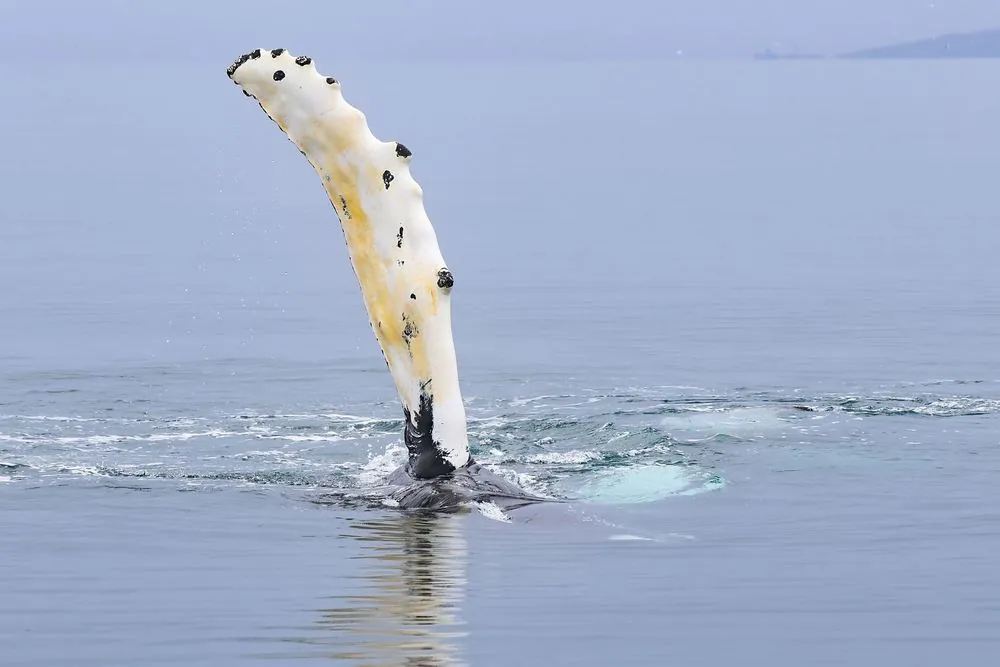
Its very long pectoral fins, nearly a third of its body, are characteristic of the species.
The humpback whale (Megaptera novaeangliae) is the undisputed star of the season. It's a rorqual massive yet surprisingly acrobatic, recognisable by its very long pectoral fins — nearly a third of its body length — and by its tail fin (the fluke), whose underside, unique to each individual, allows scientists to identify them like a fingerprint.
14–16 m
Length of an adult
~30 t
Average weight
~11 months
Gestation period
~8000 km
Migration distance
Curious and often demonstrative, the humpback whale displays many surface behaviours: full breaches out of the water (breaching), fin and tail slaps, deep dives. The males are also renowned for their songs, long, complex melodies that can last for hours and travel for kilometres. During their Caribbean stay, the whales feed very little: they live on the fat reserves built up over summer in the cold waters.
When to see them
The whale-watching season in Martinique runs mainly from February to April. The migration actually begins as early as December-January, when the first whales arrive in the Caribbean, but it's from February to April that encounters are most frequent, when mothers and their calves cruise along the coast in calm waters.
December – January : start of the season, first arrivals, still irregular presence.
February – April : heart of the season, peak watching, mothers and calves close to the coast.
May : end of the season, the whales gradually head back north.
Within a single day, the early-morning departures are the most favourable: the sea is calmer, visibility better, and the cetaceans more active at the surface. In the middle of the day, the heat often prompts the animals into longer dives, reducing the chances of spotting them.
Where to see them
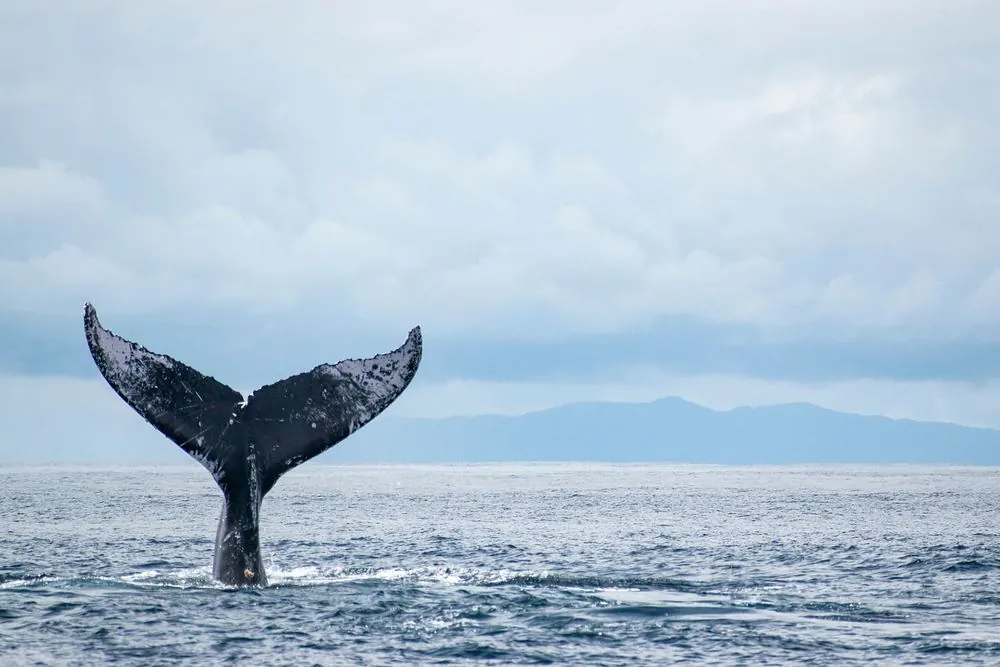
The fluke raised as it dives: its unique pattern identifies each individual.
Humpback whales are found mainly in the Caribbean coast, on the leeward side of the island, where the sea is more sheltered. Departing from Anse à l'Âne, our trips run along areas renowned for encounters:
The bay of Fort-de-France and its surroundings, a vast sheltered stretch of water.
The area from Case-Pilote to Saint-Pierre, north of the bay, in the deep waters close to the coast.
The whole of the AGOA sanctuary, a refuge for the marine mammals of the French Antilles, which our excursions cross.
These deep waters close to the shore, characteristic of the Caribbean side, allow the great cetaceans to come quite close to the coast. Nothing is ever guaranteed with wild animals in the open, but our captains' experience and their knowledge of the migration corridors maximise the chances of a wonderful encounter. A blow spotted on the horizon, and the whole crew holds its breath.
What you'll see
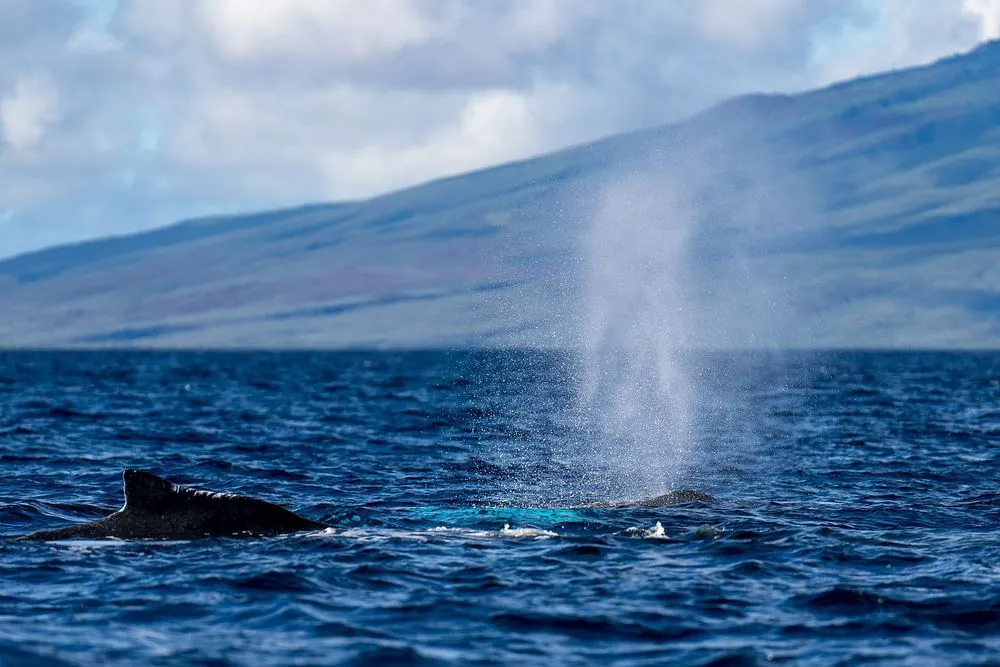
The blow, a column of vapour visible from afar, is often the first sign of a presence.
Watching a humpback whale means first learning to read the surface of the sea. Several signs give away their presence and punctuate the encounter:
The blow — the column of vapour, sometimes visible several hundred metres away, is often the first sign.
The breach (breaching) — the whale launches out of the water and crashes back down in a spray of foam: the most spectacular moment.
Fin and tail slaps — slapping of the long pectoral fins or the fluke at the surface.
The sounding dive — when the whale raises its tail before a deep dive, revealing the underside of its fluke.
The songs — in good conditions, you can sometimes hear the males' melodies through the hull.
These behaviours are all the more moving as they unfold in a magnificent setting, between the Caribbean Sea and the island's peaks. Every trip is different: nature can't be commanded, and that too is part of the magic of the moment.
Migration & breeding
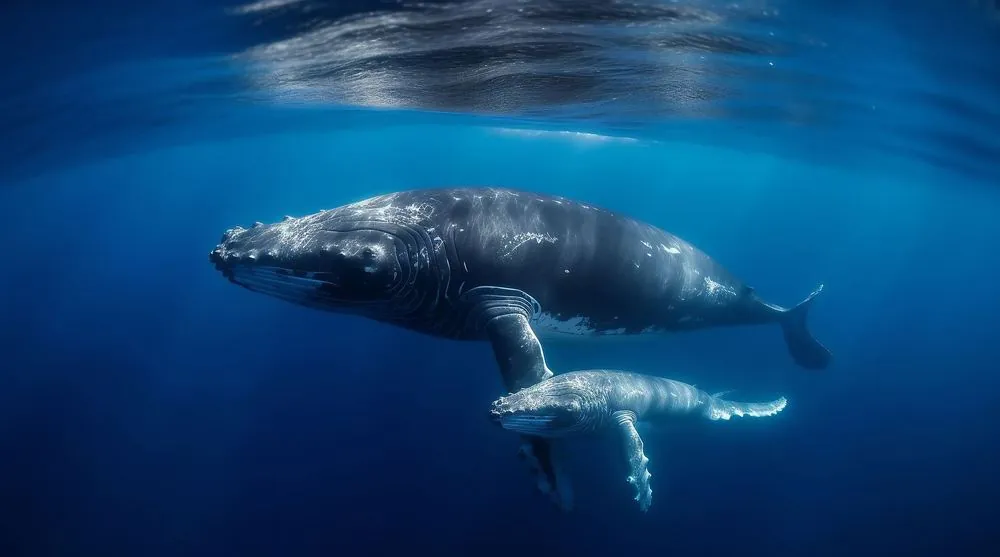
A mother and her calf: it's to give birth that the whales come to the warm waters of the Caribbean.
The whales' arrival in Martinique is part of one of the greatest migrations in the animal kingdom. Every year, humpback whales leave the cold, food-rich waters of the North Atlantic, where they spend the summer feeding on krill and small fish, to reach the warm waters of the Caribbean — a journey of several thousand kilometres.
If they undertake this journey, it's for breeding. The warm, calm waters of the Caribbean offer an ideal setting for calving and the first weeks of the calves' lives. At birth, a calf already measures 4 to 5 metres and suckles an extremely rich milk that lets it grow very fast, before facing the long journey back north alongside its mother.
It's this presence of mothers and newborns that makes the season so precious, and responsible watching so important: disturbing a mother and her calf can jeopardise their rest and feeding at a crucial moment in their life cycle.
The other cetaceans
Whale season is also a chance to come across other cetaceans, which are present year-round in the island's waters:
Short-finned pilot whale
Globicephala macrorhynchus
This "pilot whale", with its rounded forehead and dark colouring, lives in tight-knit groups. It's one of the large dolphins most regularly seen in Martinique.
Sperm whale
Physeter macrocephalus
The largest of the toothed cetaceans, recognisable by its massive head and its angled blow. An exceptional diver, it frequents the deep waters offshore.
Dolphins
Tursiops, Stenella…
Bottlenose dolphins and spotted dolphins often join the trips, in playful displays around the boat.
And many more
False killer whale, orca, Kogia…
Rarer still, other species can surprise attentive observers.
To learn all about the island's cetacean fauna, discover our guide dedicated to the marine mammals of Martinique.
Watching responsibly
Humpback whales are protected animals, and watching them is governed by the AGOA sanctuary, a refuge for the marine mammals of the French Antilles. The goal is simple: enjoy the show without ever disturbing the animals, particularly mothers and their calves.
Minimum distance of 100 metres — you never come closer, and you don't surround the animals.
No pursuit — you don't cut across their path and always leave a clear way out.
Reduced speed and steady course — no acceleration or sudden manoeuvre nearby.
No swimming with the whales — the approach is made only from the boat.
Limited watching time — you keep the encounter short so as not to disturb natural behaviours.
Planète Dauphins is a signatory of the Marine Mammal Approach Charter and scrupulously respects these rules. Watching whales responsibly means ensuring that this magical gathering happens again, season after season.
Making the most of your trip
A few simple tips to give yourself the best chances and make the most of the trip:
Choose a morning departure : calmer sea, better visibility, cetaceans more active at the surface.
Bring sun protection : a cap, sunglasses, sunscreen (preferably ocean-friendly) and water.
If you're prone to seasickness, take precautions before boarding and keep your eyes on the horizon.
Keep an eye on the horizon : the blow is often the first sign of a presence.
Be patient and considerate : these are wild, free animals; the encounter is a privilege, not a guarantee.
A camera or a well-charged smartphone will be your best ally for capturing a breach — but don't forget to enjoy the moment too, your eyes lost in the deep blue.
Set sail with us
During the season, we set out to meet the humpback whales fromAnse à l'Âne, in Les Trois-Îlets. The half-day at sea combines the search for whales and dolphin watching, with the expertise of a passionate crew who know the migration corridors and scrupulously respect the marine mammal approach charter.
On board, the crew helps you spot the blows and explains the behaviours you observe, so the encounter is as beautiful as it is enlightening. The comfort and safety of passengers, like the peace of the animals, remain our priority throughout the trip.
An exceptional morning on the Caribbean coast, watching for blows on the horizon and, with a little luck, witnessing one of the finest shows nature has to offer. Places are limited and the season is short: it's best to book in advance so you don't miss this unique gathering.
Frequently asked questions
The season runs mainly from February to April, with a peak at the heart of the season. The first whales arrive as early as December-January and leave during May.
No: these are wild, free animals, and no sighting can be guaranteed. The captains' experience and their knowledge of the migration corridors do, however, significantly increase the chances.
No, it's forbidden. Watching is done only from the boat, at least 100 metres away, in respect of the AGOA sanctuary.
Mainly the humpback whale (Megaptera novaeangliae), which comes to give birth in the warm waters of the Caribbean. Other cetaceans such as the pilot whale or the sperm whale may also be encountered.
In the morning: the sea is calmer, visibility better and the whales more active at the surface.
From Anse à l'Âne or Anse Mitan, in Les Trois-Îlets, on the Caribbean coast of Martinique.
February → April
The great whale gathering
Every season, humpback whales come to the Caribbean coast to give birth. Set out to meet them from Anse à l'Âne, in respect of the AGOA sanctuary.